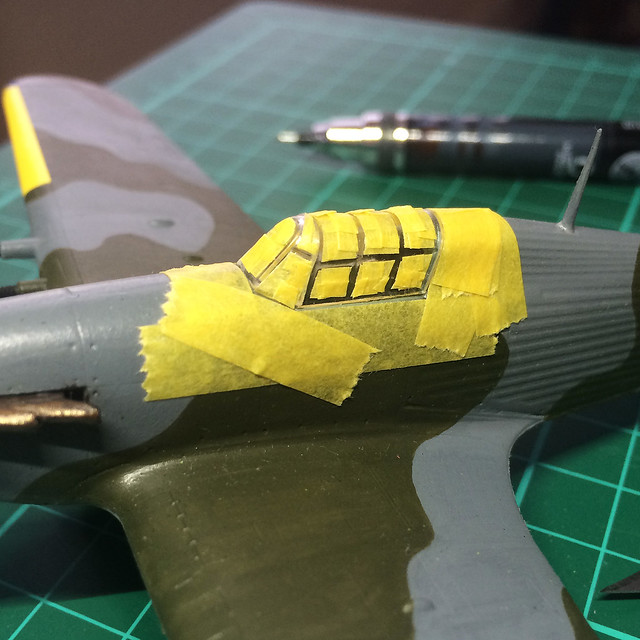
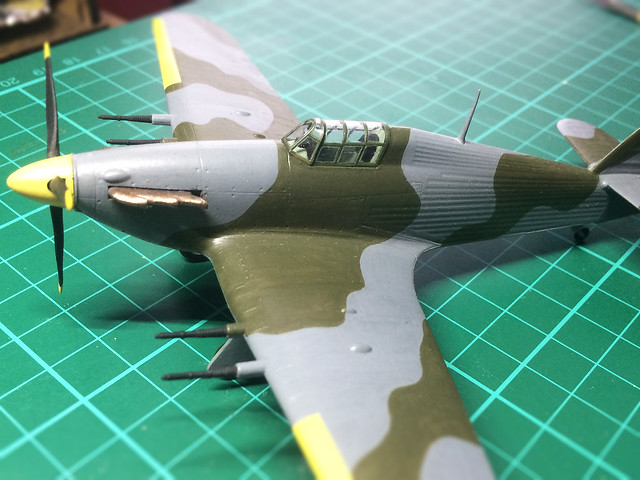
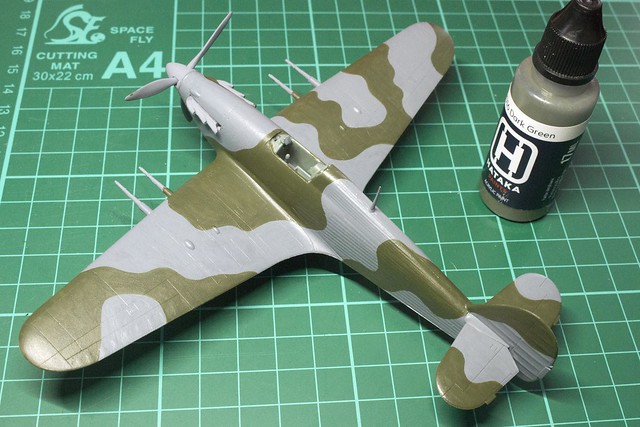
Having had time to reflect, I thought I would comment in a bit more balanced way about Hataka paints...
At the core of my annoyance is the frustrating fact that Hataka paints seem to be so darn promising. Thier specially customised colour sets - themed and put together to support specific historical projects - seem to be very well researched and the colour matching, also, seems very well done. In short, they appear to be exactly what the military scale modeller is after.
I bought the 'Battle of Britain/D-Day RAF' paint set (for my Tomahawk IIA project) and right up to the moment that paint touched plastic they looked like they were a winner. However, it was what happened during application that left me exceedingly disappointed.
I used my Revell airbrush to apply the paints and my early experimentation convinced me that - out the bottle - Hataka paints were just a little too 'gloopy' to flow nicely through my airbrush. Indeed, in my experience, the Hataka paint, when used neat, seemed to congeal (dry) surprisingly fast, leaving my airbrush blocked halfway through my spraying session (my brush is a top-loading cup airbrush and I only used half of one-third of the cup before the flow of paint packed in).
Now, this - to me - seemed quite normal, it just meant that the Hataka paint needed thinning to aid the consistent and unfettered flow through the brush. So, the next thing was to determine just how much thinning the paint needed.
I used Vallejo airbrush thinners (and also tried Tamiya thinners), but I
could not find the sweet spot between too thick and too runny. Just a drop of Vallejo thinners in the Hataka paint seemed to cause it to become overly thin and splatter and create droplets on my primed surface. I have never experienced this effect using Vallejo paints...
 |
The result of just a couple of small drops of Vallejo thinners added to the
(well mixed) Hataka paint. It was weak and splattered a lot. |
Disgruntled, I referred back to my earlier post about the Hataka paint I used in my Airfix Tomahawk project and discovered that I had the same problem (but forgot about it) and that I had found some suggestions online on how to deal with the paint.
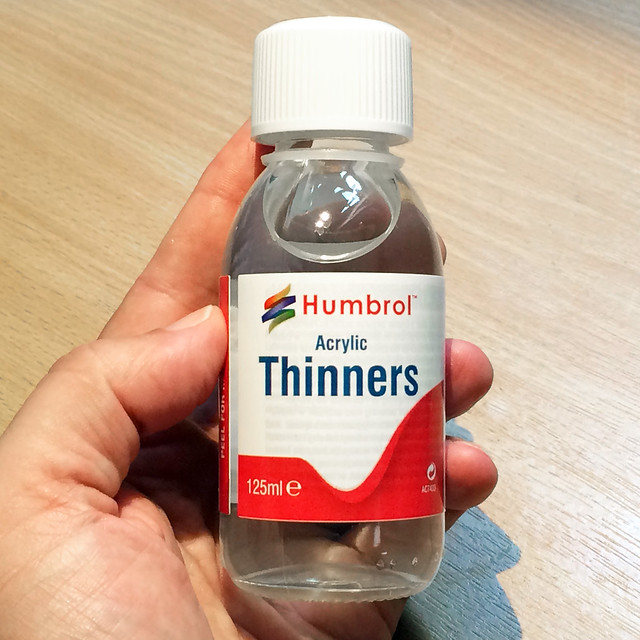
The issue did seem to be that Hataka is very choosy when it comes to thinners. Others who had tried the paint - and been subjected to the same issues that I had suffered - had found that good old Humbrol Acrylic Thinners appeared to be the most compatible with Hataka paints (though I not that Hataka have produced their own thinners now). So I sent off for some Humbrol thinners...
I was a bit pessimistic that something as generic as Humbrol thinners could be the solution (if you will excuse the pun). But I gave it a try, adding just one drop from a pipette into my airbrush paint cup...But guess what?
I got a far better result. Coverage was more consistent and opaque and flow was more forthcoming through my airbrush.
The flow was still a little reluctant, but I didn't want to add any more thinners in case it went the other way again, so persevered using a low pressure to avoid any further splattering (which seemed to work).
Conclusion
I still don't like Hataka paints. The flow of the paint just didn't 'feel' comfortable for me when compared to the lovely, unforced, spray-flow that I have achieved using Vallejo's pre-thinned 'Model Air' brand of paints.
As I said in the beginning, Hataka paint sets seem such a good idea, and I do like the colour matching (which in some instances seems more authentic than some of Vallejo's). But good colours are no good if they do not apply easily and smoothly - and this was not my experience with Hataka paints I'm afraid. I will not be using them again.